
 Contact-us



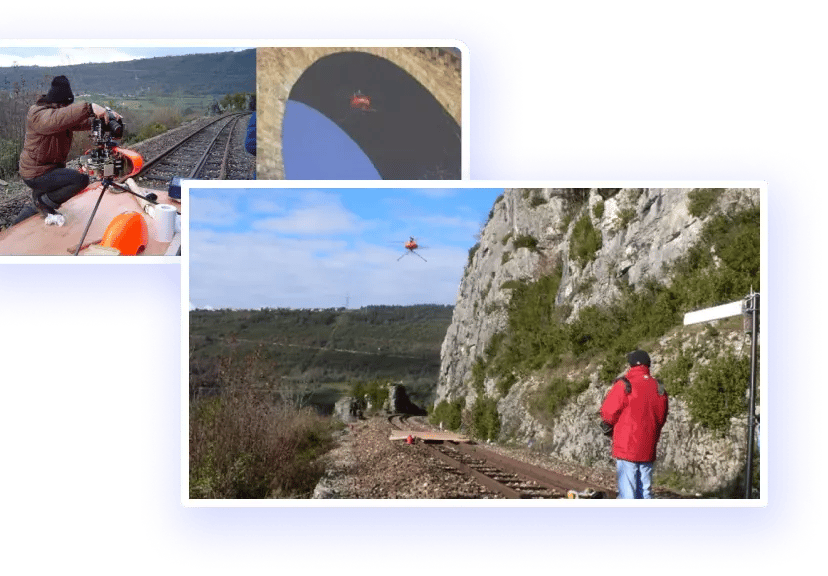
The project began with the meeting of three railway workers, all experts in engineering, design, and maintenance of railway lines at SNCF Infra (formerly SNCF Réseau):
- Grégoire GOUSSU: geotechnical engineer, high‑speed rail line designer, and aeromodelling enthusiast
- Nicolas POLLET: geologist with a passion for risk management and innovation
- Flavien VIGUIER: railway surveyor‑topographer and LiDAR aficionado
In 2006, they attended the very first drone trials conducted on the line known as “Les Carpates” (from Bourg‑en‑Bresse to Bellegarde‑sur‑Valserine), which was closed to traffic at the time (prior to the modernization works that later enabled TGV connections toward Switzerland).
The objective was to perform inspections of civil engineering structures and earthworks along the line, including the magnificent Cize‑Bolozon viaduct and the large rock slope extending along the route.
The failure of these demonstrations left a strong impression on the SNCF teams, highlighting the need for significant technical and regulatory developments before drone technology could be used at an industrial level.
This experience laid the foundation for everything that followed!
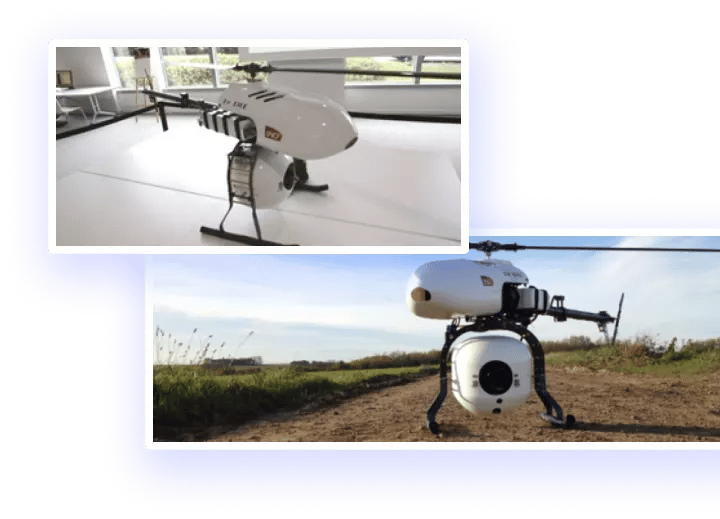
In France, 2011 marked the arrival of the first regulations dedicated to drone usage. Manufacturers were offering “drone systems” capable of carrying a “payload,” which could be operated under an authorization issued by the prefecture, itself supported by the Civil Aviation Safety Directorate (DSAC).
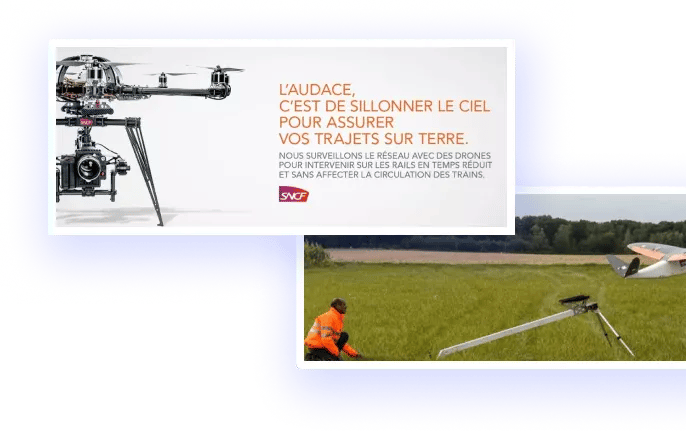
Flavien, Grégoire, and Nicolas therefore embarked on a techno‑push approach with their first drone, the Helipse HE190, operated by Grégoire (the duo is still perfectly operational today!).
A vision quickly emerged:
the drone is a tool for collecting high‑quality data for operational teams, without impacting railway operations, while improving safety conditions and productivity.
This was the era of innovation carried out “in their spare time” for Flavien, Grégoire, and Nicolas.
Their learning was made possible thanks to a management style combining trust and high standards, supported by caring colleagues:
“Drones, ok… but don’t forget your day job.”
(Alexandre NARCY, Bruno LANDES, and Emmanuel MANIER)
This spirit gave rise to the Synapses network, gathering SNCF Group’s scientific and technical experts, built around a single motto: “DARE.”
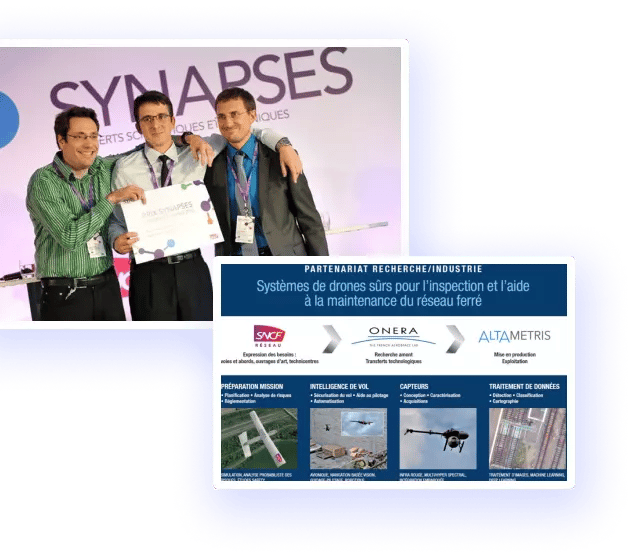
In 2013, the demonstrator was validated, marking the beginning of a broader exploration of use cases, sponsored by the Technical Directorate for Network Maintenance, with the valuable support of André FAUVE‑PIOT, Eric BIDON, and Hugues GIGLEUX, among others.
Grégoire, Nicolas, and Flavien then shifted into full project mode, with a dedicated resource (Jérémy ZERBIB), a budget, structured support, and a methodology — thanks to the contributions of Gilles SAUSSINE, Dominique LAOUSSE, Cédric BROGARD, the Innovation & Research teams, and the entire Synapses network of SNCF scientific and technical experts.
April 5th, 2017: creation of Altametris as a fully operational legal subsidiary.
A team of 16 people was already in place, and the objective shifted — the company now needed to deliver results in order to operate sustainably and secure the resources required for investment.
The financial balance was achieved within four years, growing from zero to several million euros in revenue.
As a spin‑off from SNCF Réseau, the Supervisory Board evolved to support industrialization and the digital transformation of the business lines — while the team strengthened its capabilities with new expertise, particularly in software development and machine learning.
The first deployed offer — SOLUTIONS — consisted of service operations for data collection and processing using drones and helicopters (via partners).
Initially focused on topography and safety/security, the offer expanded by specializing along business lines (civil engineering, electrical equipment, telecommunications, etc.) to deliver actionable knowledge.
Altametris positioned itself in the fields of digital twins, Building Information Modeling (BIM), and Digital Asset Management.
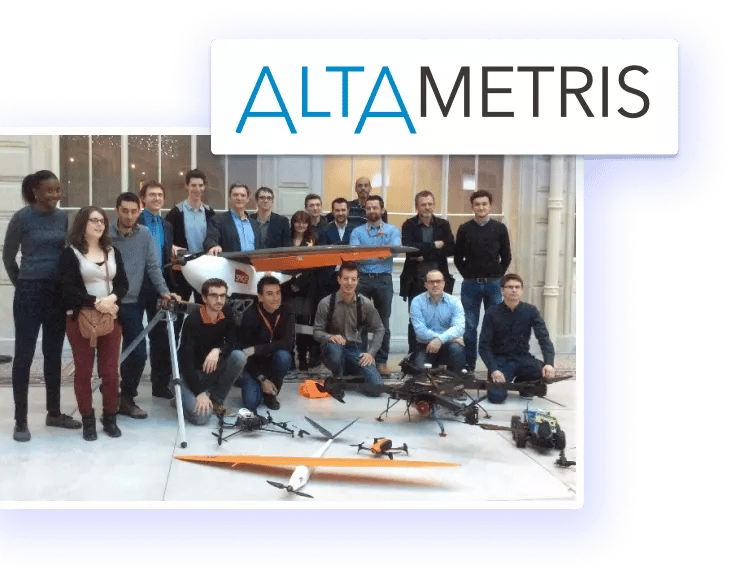
April 5th, 2017: creation of Altametris as a fully operational legal subsidiary.
A team of 16 people was already in place, and the objective shifted — the company now needed to deliver results in order to operate sustainably and secure the resources required for investment.
The financial balance was achieved within four years, growing from zero to several million euros in revenue.
As a spin‑off from SNCF Réseau, the Supervisory Board evolved to support industrialization and the digital transformation of the business lines — while the team strengthened its capabilities with new expertise, particularly in software development and machine learning.
The first deployed offer — SOLUTIONS — consisted of service operations for data collection and processing using drones and helicopters (via partners).
Initially focused on topography and safety/security, the offer expanded by specializing along business lines (civil engineering, electrical equipment, telecommunications, etc.) to deliver actionable knowledge.
Altametris positioned itself in the fields of digital twins, Building Information Modeling (BIM), and Digital Asset Management.
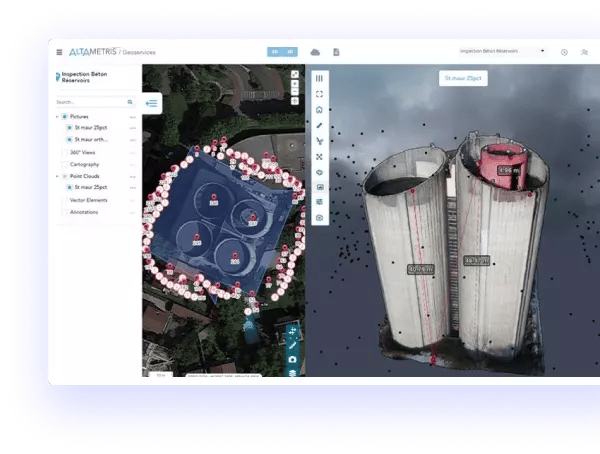
2021: a new milestone — Altametris launches its SaaS middleware solution, Altametris Suite.
Its purpose is to bridge the gap between data collected by any agile solution (mobile tools, IoT devices) and EAM systems (Enterprise Asset Management, such as ERP), by integrating smoothly and flexibly within a SMART and efficient approach — digitalizing without having to overhaul everything.
The loop is closed, performance is secured, and the future lies in predictive capabilities!
.png.webp?width=64&height=58&name=Group+(5).png.webp)
To use drones to collect high‑quality data for operational teams, without impacting railway operations, while improving safety conditions and productivity. .png.webp?width=25&height=24&name=Group+(6).png.webp)
We have clearly demonstrated the value of drone technology — to the point of being recognized as “the drone subsidiary” of SNCF Réseau.
However, our core objective has always been to deliver performance through data, beyond the aerial vector itself, no matter how agile it may be.
This is why we have continuously evolved our offering over the years, in line with the changing needs of our customers.